
Introduction
In today’s post, I will describe the synthesis of phenytoin, a broadly prescribed anticonvulsant drug categorized as an essential medicine by the World Health Organization. Phenytoin can be prepared by reacting urea with benzil, the synthesis of which I discussed in a previous post. The overall scheme is the following:
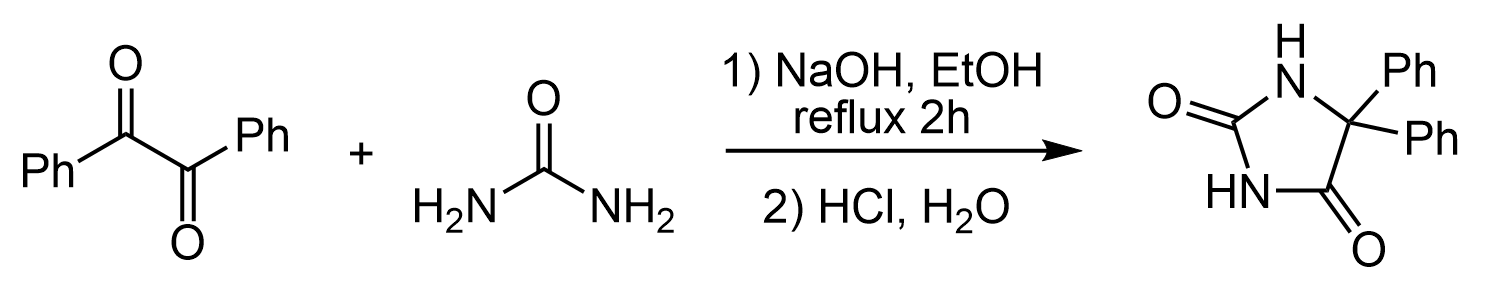
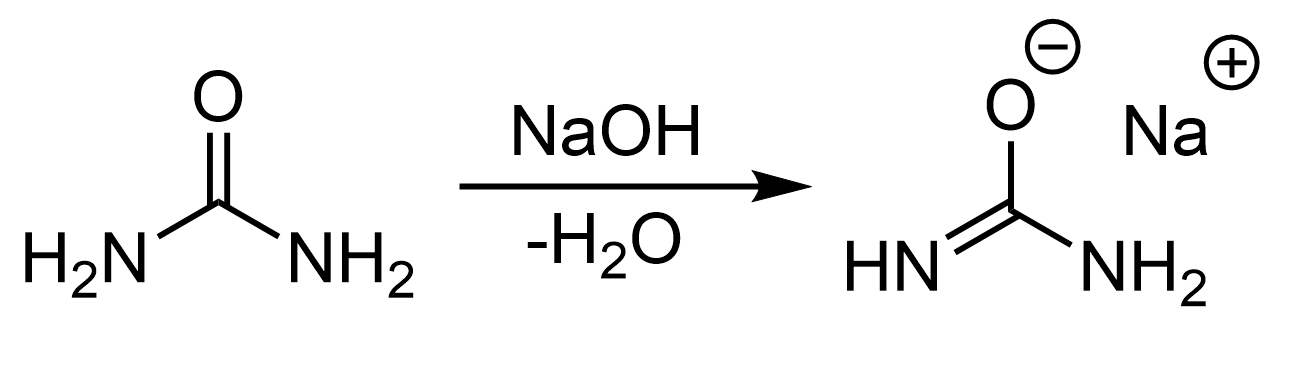
The reaction, discovered by the German chemist Heinrich Biltz, is base-catalyzed and proceeds through a fascinating cascade mechanism. The reaction starts with the deprotonation of urea by sodium hydroxide to generate a nucleophilic anion.
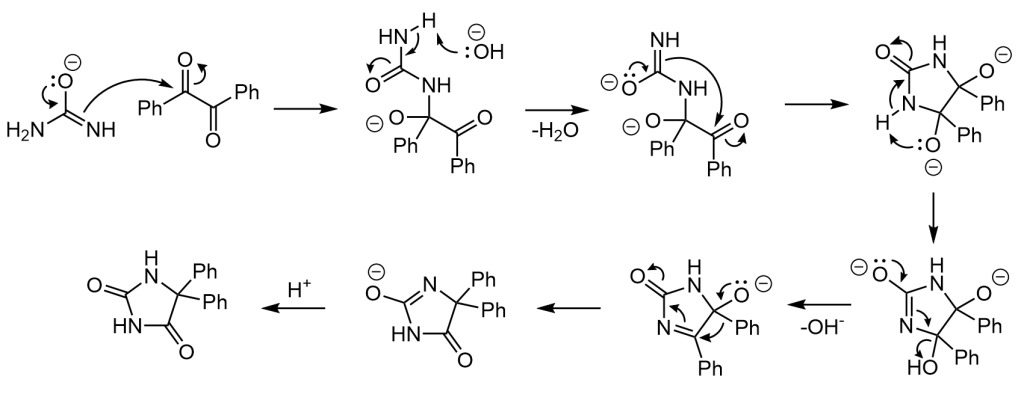
The generated anion attacks one of the carbonyl groups of the benzil molecule, forming an addition intermediate that, after deprotonation of the other end of the urea moiety, further reacts with the second carbonyl group. This creates a five-membered ring which, after proton exchange, expels a hydroxide ion to form a partially conjugated 1,5-dihydro-imidazol-2-one intermediate. In this state, one of the nitrogen atoms of the original urea molecule adopts an imine-like structure around one of the former benzil carbonyl carbons, while the other nitrogen remains involved in a tetrahedral intermediate. The system then evolves by reforming the carbonyl moiety and, driving a pinacol-type 1,2-shift of a phenyl group, completes the formation of the hydantoin ring. Once the reaction is complete, the final product is isolated as a neutral molecule via acid neutralization.
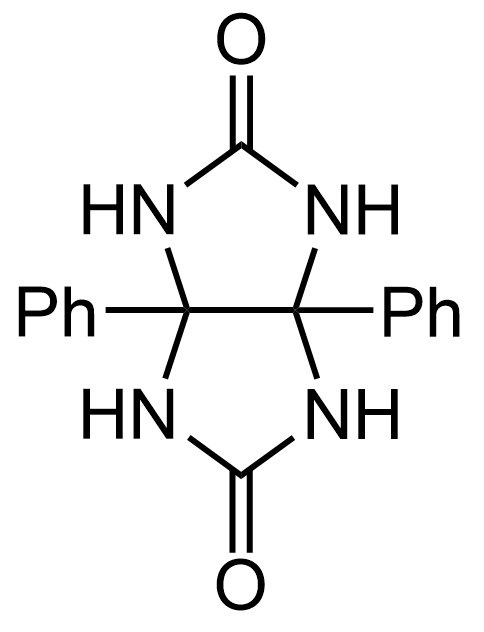
The reaction is a classic in organic synthesis and has been widely studied in the literature. For the interested reader, I highly recommend the paper by Puccetti et al. (Chem. Eur. J. 2022, 28, e202104409), which explores the application of mechanochemistry to the synthesis of phenytoin. The paper is rich in valuable details; for instance, it demonstrates how an independently synthesized diol intermediate (the step prior to the hydroxide elimination) spontaneously yields phenytoin when milled with KOH, providing elegant experimental support for the accepted mechanism. Furthermore, the authors provide useful practical insights into the reaction setup and byproduct formation, showing how exceeding 1 equivalent of urea leads to an increasing production of the double-addition product.
The latter observation is particularly interesting since, in many literature procedures, the molar ratio of urea to benzil routinely exceeds the 1.0 equivalent mark. For example, in the field of microwave-assisted synthesis, 1.75 eq. of urea are reported by Gbaguidi et al. (AJPAC, 2011, 5(7), 168-175), while 2.0 eq. are used in the method described by Nagar et al. (Asian J. Research Chem. 2011, 4(4), 619-620). A 2.0 eq. ratio is also cited by Ashfaque Alam et al. (WJPLS, 2023, 9(4), 110-113) as the traditional approach for phenytoin synthesis. In this post, I will also adopt the classic 2:1 molar ratio of urea to benzil. I hope to revisit this topic in the future for a more in-depth evaluation of the reaction’s byproducts and to study how the yield depends on the initial molar ratios.
Experimental Part
In a 100 mL round flask, 1.58 g of benzil (7.52 mmol, 1.0 eq.) and 0.95 g of urea (15.8 mmol, 2.1 eq.) were dissolved in 15 mL of 95% ethanol. To this solution, 4.7 mL of a 30% aqueous sodium hydroxide solution (~1.33 g/mL, 46.7 mmol, 6.2 eq.) were added. The mixture immediately turned whitish, and a precipitate formed. The reaction mixture was refluxed for 2 hours, during which it turned a yellow/orange color. After the reflux, 45 mL of water were added, causing additional precipitate to form. The mixture was allowed to cool to room temperature, and the insoluble side products were removed by filtration. The resulting filtrate was neutralized with concentrated hydrochloric acid until an acidic pH lower than 2 was reached. The white precipitate that developed was recovered via vacuum filtration and dried over anhydrous calcium chloride. This yielded 1.59 g of crude product, corresponding to a crude yield of approximately 84%. The product was then recrystallized from boiling 95% ethanol, isolated again by vacuum filtration, washed with cold distilled water, and dried over anhydrous calcium chloride. A total of 1.19 g of short, white, needle-like crystals were recovered, resulting in a final purified yield of 62%.
FTIR characterization
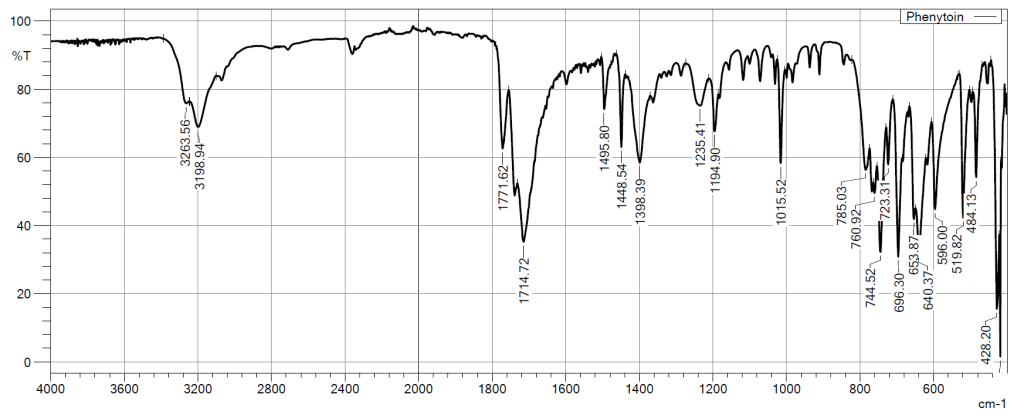
The obtained product was analyzed by Fourier-transform infrared spectroscopy (FTIR) using an attenuated total reflectance (ATR) accessory equipped with a diamond crystal. The resulting spectrum (32 scans, 2 cm−1 resolution) closely matches the spectrum reported in the literature (SDBS No. 7403). Differences in band intensity are consistent with the different sampling techniques used (ATR vs. KBr pellet) and possibly sample dryiness.
🔬 Analytical Characterization Pending
Product characterization is currently underway. This post will be updated with the experimental 1H/13C-NMR spectra as soon as the analytical data acquisition and processing are completed. Stay tuned!