
Introduction
In today’s post, I will describe the oxidation of benzoin to benzil using nitric acid. This reaction is a classic in organic synthesis and allows for the preparation of benzil in good yields. The overall reaction scheme is the following:
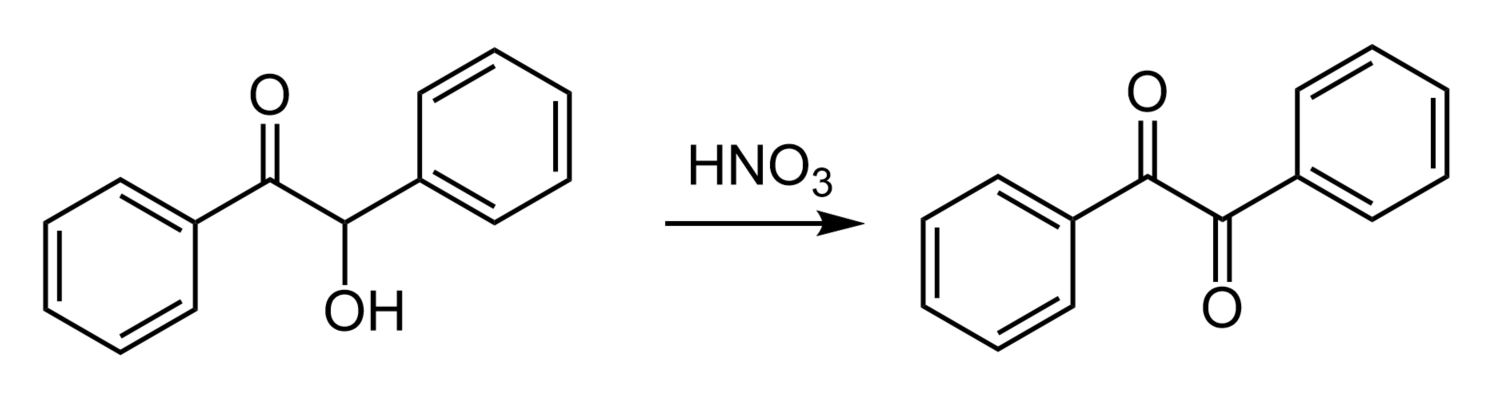
Drawing a detailed mechanism for this oxidation is not straightforward, and it is quite possible that several competing pathways are involved. As a general representation, one may envisage the initial formation of a nitrate ester from the α-hydroxy ketone, which subsequently undergoes oxidation to the corresponding diketone through internal redox processes. A simplified representation of the overall mechanism is the following:
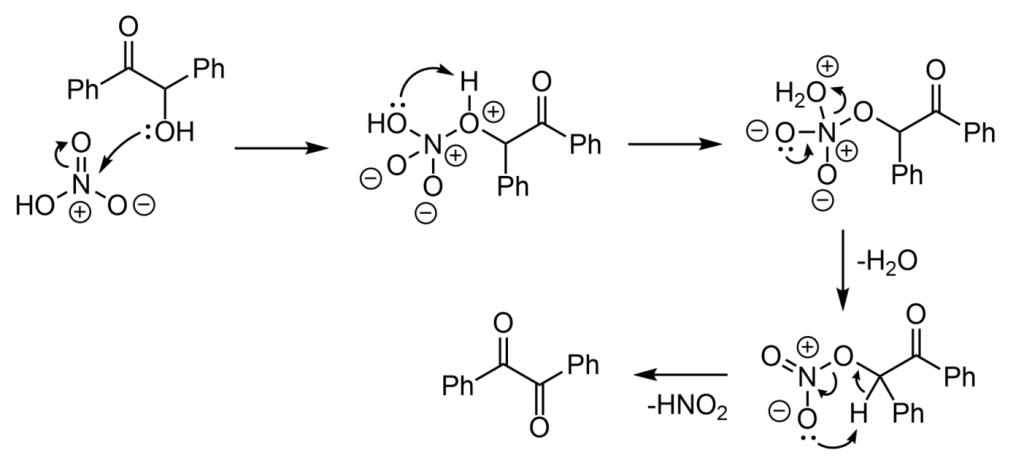
In the first step, the oxygen atom of the hydroxyl group attacks the electrophilic nitrogen of a nitric acid molecule (or of an activated species generated by protonation of nitric acid), leading to an intermediate that, through a series of proton transfers (represented here as intramolecular for simplicity), eliminates water to afford the corresponding nitrate ester. This intermediate can then evolve via the transfer of the hydrogen attached to the α-carbon to the nitrate moiety, accompanied by the reduction of the latter and the formation of a nitrous species, represented here as nitrous acid (HONO). Such species are unstable under the reaction conditions and may participate in further redox and disproportionation processes, ultimately leading to nitrogen oxides such as NO and NO₂.
Before moving on to the experimental part, let me add a small remark for the reader regarding the synthesis of benzil. Although using concentrated nitric acid is simple and widely adopted, it is worth noting that this reaction is not always the cleanest or most controllable. The final product can often be contaminated with unreacted benzoin [1] or, if harsher conditions are applied, over-oxidation and side reactions may occur. A cleaner and more controlled alternative utilizes copper(II) as an oxidant, either in stoichiometric quantities [1] or, more conveniently, in catalytic amounts. In the latter case, a secondary oxidizing agent is employed to re-oxidize the copper(I) species generated during the reduction cycle. Some authors have utilized the direct air oxidation of copper sulfate in pyridine [2], while others suggest using copper(II) acetate in glacial acetic acid in the presence of ammonium nitrate [3]. The US2658920A patent even suggests introducing a catalytic amount of an alkaline nitrite (such as sodium, potassium, or ammonium nitrite) to assist in the conversion of any copper(I) oxide formed during the reaction.
Experimental Part
In a 100 mL flask equipped with a magnetic stir bar, 2 g of benzoin (9.42 mmol, 1 eq.) were suspended in a mixture of 9.3 mL of 65% nitric acid (134.3 mmol, 14.2 eq.) and 0.7 mL of deionized water. The water was added to tame the reaction, as performing it directly with pure 65% nitric acid can be quite vigorous. The mixture was heated for 1 h in a boiling water bath until no trace of brown nitrogen oxide fumes was visible. This step is critical; interrupting the reaction too early has a negative impact on the yield. Having performed this reaction before, I previously stopped after only 40 minutes when only a faint presence of brown gas was observed, which noticeably reduced the final yield. After one hour of heating, the mixture was slowly poured into 100 mL of cold water under constant, vigorous stirring, resulting in the immediate formation of a yellowish precipitate. The mixture was allowed to cool, and the solid was recovered by vacuum filtration and washed a few times with cold water. The crude product was dried over anhydrous calcium chloride, yielding a final mass of 1.89 g.
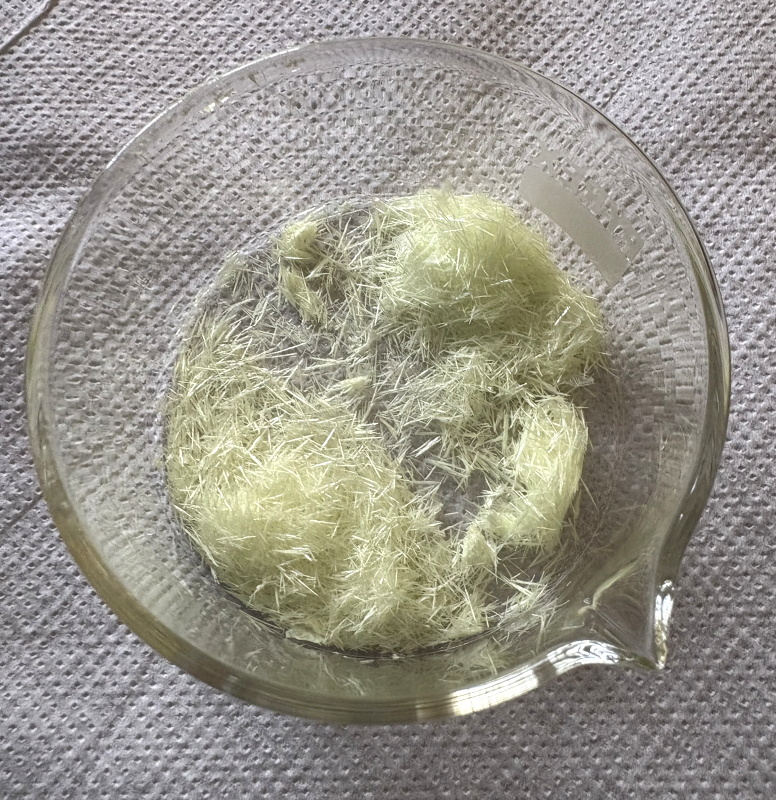
The crude product was recrystallized from a mixture of ethanol and water, where the latter acts as the anti-solvent to minimize product loss. Based on my observations, it is worth noting that in concentrated solutions of benzil in ethanol/water, the product tends to “oil out” into small liquid droplets, likely due to the relatively low melting point of benzil (94–96°C). Consequently, it is not uncommon for the solution to undergo a sudden product crash-out upon cooling rather than proper crystallization. Adding an appropriate amount of ethanol usually resolves this issue. Once successful crystallization was achieved, long, yellow, needle-like crystals formed. These were recovered by vacuum filtration, washed with water, and dried over anhydrous calcium chloride, affording a final mass of 1.49 g of benzil corresponding to a 75% yield.
On a side note, I observed that adding water to the filtration mother liquor lowers the solubility and allows for the recovery of additional benzil crystals. However, upon recrystallization of this second crop, I often noticed the co-precipitation of two distinct sets of crystals: yellow needles of benzil and shorter white crystals, possibly representing unreacted benzoin or other side products. For this reason, I chose not to isolate that fraction. If higher purity and yields are desired, column chromatography represents a superior alternative, as the more polar benzoin can be easily separated from the benzil product.
FTIR characterization
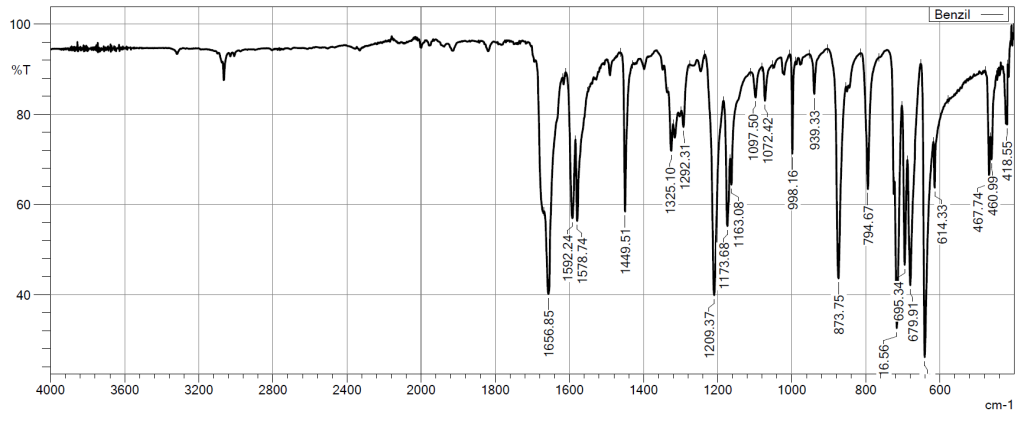
The obtained product was analyzed by Fourier-transform infrared spectroscopy (FTIR) using an attenuated total reflectance (ATR) accessory equipped with a diamond crystal. The resulting spectrum (32 scans, 2 cm−1 resolution) matches the spectrum reported in the literature (SDBS No. 871) reasonably closely. Differences in band intensity are consistent with the different sampling techniques used (ATR vs. KBr pellet). As can be seen, the characteristic O–H stretching bands of benzoin, appearing in the 3400–3350 cm−1 region, are substantially absent from the recorded spectrum of the benzil product. This is consistent with good conversion of the starting material and suggests that little to no benzoin remains after recrystallization.
🔬 Analytical Characterization Pending
Product characterization is currently underway. This post will be updated with the experimental 1H/13C-NMR spectra as soon as the analytical data acquisition and processing are completed. Stay tuned!