
Introduction
In today’s post, I will discuss the synthesis of anthranilic acid via the Hofmann rearrangement of phthalimide using sodium dichloroisocyanurate (NaDCC) as the halogenating agent.
Anthranilic acid is a very interesting intermediate and can be used in the preparation of many compounds, including azo dyes (e.g. methyl red), the artificial sweetener saccharin, various esters with applications in the fragrance industry, insect repellents, and several pharmaceuticals. Anthranilic acid is also a particularly interesting precursor for the in-situ generation of benzyne via diazotization, followed by spontaneous decarboxylation with loss of nitrogen.
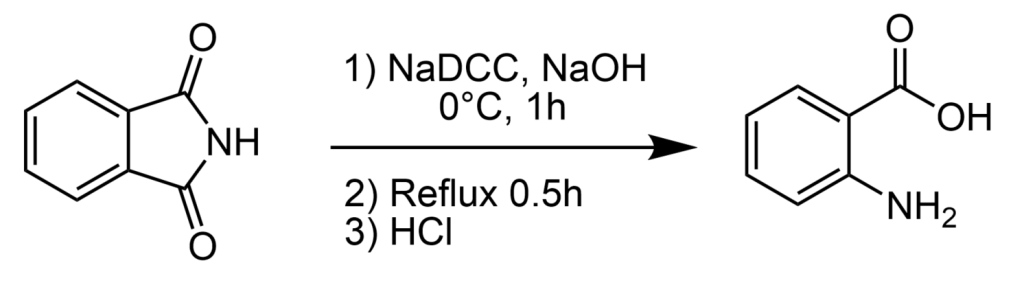
The overall reaction scheme is the following:
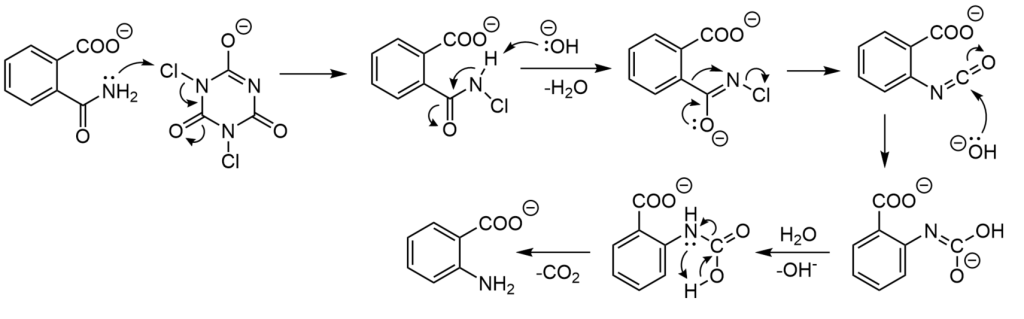
The reaction mechanism starts with the base-induced hydrolysis of phthalimide. A hydroxide ion attacks one of the carbonyl groups of the cyclic imide, forming a tetrahedral intermediate. Following proton exchange, the intermediate collapses with cleavage of the C–N bond, opening the imide ring and generating a carboxylate group ortho to the amide group.

After ring opening, the resulting intermediate can undergo N-chlorination. This may occur either through direct reaction with NaDCC, its monochlorinated derivative, or with hypochlorite species generated by the hydrolysis of NaDCC in the aqueous reaction medium. The resulting N-chloroamide is considerably more acidic than the parent amide, owing to the combined electron-withdrawing effects of the N–Cl bond and the adjacent carbonyl group. It can therefore be readily deprotonated by hydroxide, generating the corresponding nitrogen anion. This anion then undergoes the characteristic 1,2-aryl shift of the Hofmann rearrangement, with simultaneous loss of chloride, to form an isocyanate intermediate. In the basic reaction medium, the isocyanate is subsequently attacked by hydroxide, generating an unstable carbamate intermediate. This species spontaneously undergoes decarboxylation, ultimately liberating the corresponding amine.
The protocol described here is not new and was inspired by a paper from Bastos et al. (Tetrahedron Lett. 2021, 83, 153422), in which trichloroisocyanuric acid (TCCA) was successfully employed in the Hofmann rearrangement of both aromatic and aliphatic carboxamides and cyclic imides. TCCA, or in our case its analogue NaDCC, provides a convenient and broadly available source of active chlorine. Unlike concentrated bleach solutions, these reagents have a substantially longer shelf life and are considerably more stable during storage. They therefore represent an accessible and inexpensive alternative to traditional halogenating agents such as sodium hypochlorite, alkaline bromine, or N-bromosuccinimide (NBS), as well as to oxidants such as lead(IV) acetate and hypervalent iodine compounds.
The use of TCCA in Hofmann rearrangements is well documented in the literature. Hiegel and Hogenauer appear to have been among the first to explore the use of TCCA for the preparation of N-chloroamides in detail (Synth. Commun. 2005, 35, 2099–2105), as well as their subsequent conversion to N-substituted carbamates by treatment with sodium methoxide in methanol (Synth. Commun. 2005, 35, 2091–2098). In some circumstances, TCCA also appears to offer advantages over other reagents commonly used for these transformations, allowing cleaner reaction conditions, as discussed by Crane et al. (J. Org. Chem. 2011, 76, 277–280).
Notes on product isolation
The product can be isolated using several different approaches, the simplest of which is precipitation of anthranilic acid from the aqueous reaction mixture. This is traditionally achieved by adjusting the pH to approximately 3.5, which lies between the pKa values associated with protonation of the amino group (2.17) and deprotonation of the carboxylic acid group (4.84). At this pH, anthranilic acid has its lowest solubility and can therefore be efficiently precipitated from the aqueous solution as a neutral species.
However, some care is required when NaDCC or TCCA is used as the chlorinating reagent, since the cyanuric acid generated as a byproduct has three acidic protons, with pKa values of approximately 6.9, 11.4, and 13.5. Consequently, acidification of the reaction mixture can cause cyanuric acid to precipitate together with the desired product. To avoid this problem, in the procedure presented in this post I first acidified the reaction mixture to approximately pH 1, allowing the cyanuric acid to precipitate while anthranilic acid remained dissolved. After filtration, the filtrate was then brought back to pH 3.5, causing the anthranilic acid to precipitate.
Experimental Part
7.60 g of sodium hydroxide (190 mmol, 5.6 equiv.) were dissolved in 45 mL of deionized water and cooled in an ice bath to 0 °C. Separately, 4.56 g of sodium dichloroisocyanurate dihydrate (NaDCC·2H2O, 98% purity, 17.45 mmol, 0.51 equiv.) were dissolved in 30 mL of water and also cooled in an ice bath. Once both solutions had been prepared and chilled, 5.00 g of phthalimide (33.98 mmol, 1.0 equiv.) were added to the sodium hydroxide solution. To facilitate dissolution, an additional 25 mL of water were added to the mixture, resulting in almost complete dissolution of the solid.
The NaDCC solution was then slowly added to the reaction mixture under constant stirring, keeping the temperature below 5 °C throughout the addition. At the end of the addition, almost all the solid had dissolved, leaving an almost colorless, clear and transparent solution. The reaction mixture was then left to stir at 0 °C for over 1 h. At the end of this period, a transparent brownish-orange solution with no undissolved solid was obtained.
The reaction vessel was then equipped with a condenser, and the mixture was gently heated to reflux for over 30 min. At the end of the reflux period, the solution remained transparent and retained its original brownish-orange color. The condenser was removed, and the solution was allowed to cool before adjusting the pH to approximately 1 with a 10% hydrochloric acid solution. During neutralization, a solid precipitate formed, followed by abundant gas evolution. At strongly acidic pH, part of the precipitate redissolved.
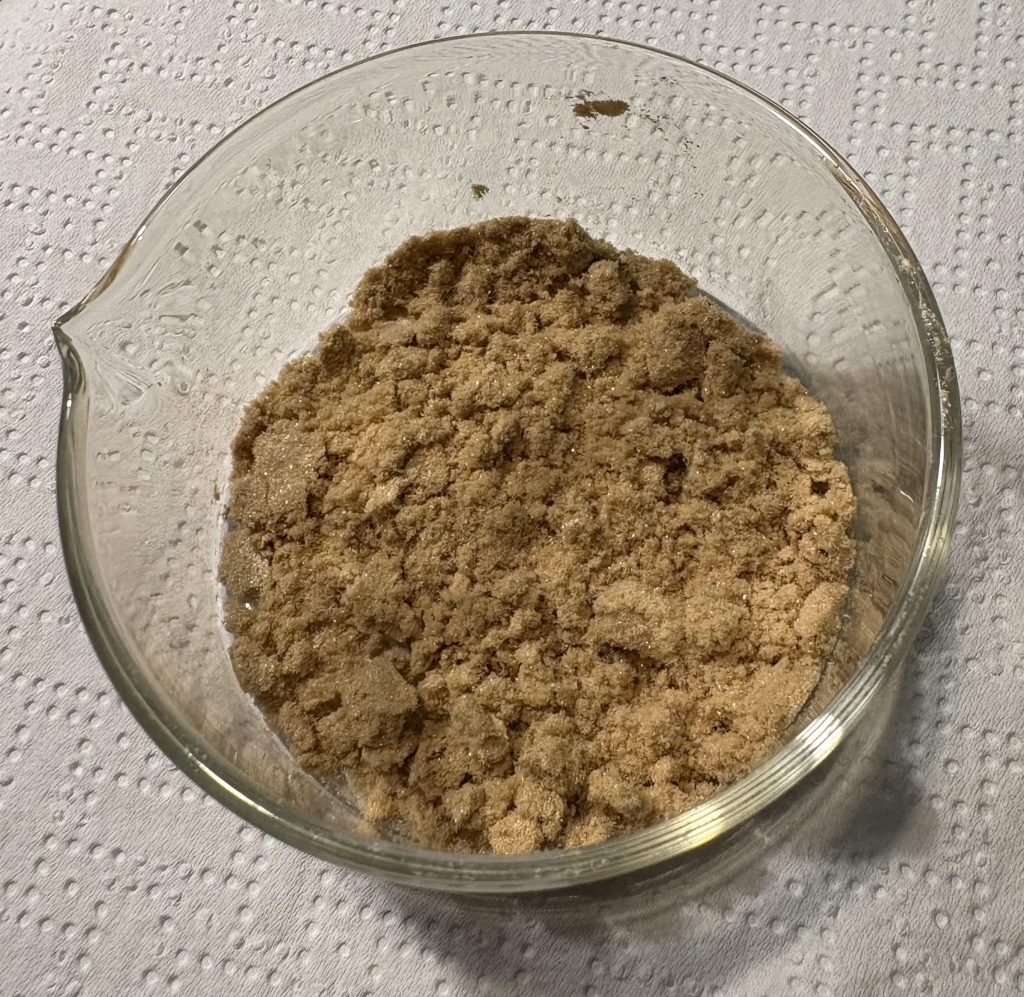
The solution, which was slightly warm due to residual heat and the exothermic neutralization, was allowed to cool completely to room temperature. The solid precipitate was then removed by filtration. The solid, consisting mainly of cyanuric acid, was discarded, and the clear filtrate was processed to isolate the product. The pH of the filtrate was adjusted to 3.5 using aqueous sodium hydroxide solution. Initially, no precipitate was observed. Scratching the wall of the vessel with a glass rod triggered crystallization. The solution was then cooled in an ice bath, and the resulting solid was recovered by vacuum filtration and washed twice with deionized water. The brownish solid obtained was dried over anhydrous calcium chloride, affording 3.13 g of product, corresponding to a 67% yield.
FTIR characterization
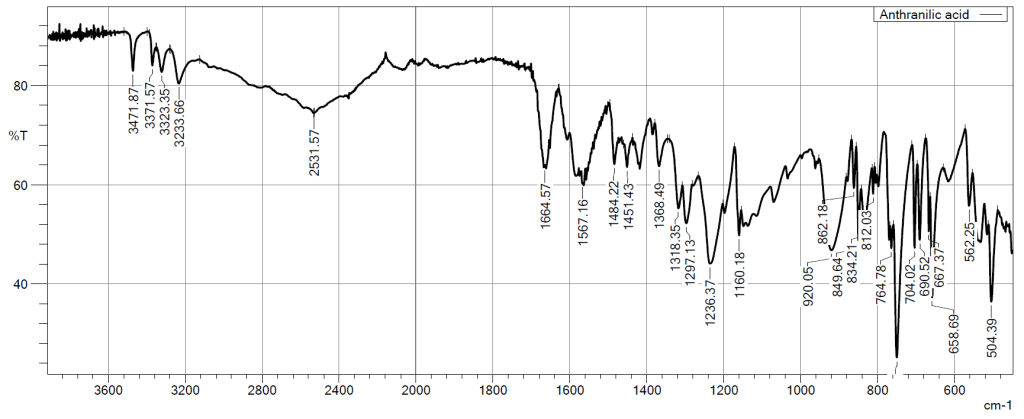
The obtained product was analyzed by Fourier-transform infrared spectroscopy (FTIR) using an attenuated total reflectance (ATR) accessory equipped with a diamond crystal. The resulting spectrum (32 scans, 2 cm−1 resolution) closely resembles the spectrum reported in the literature (SDBS No. 1150).
🔬 Analytical Characterization Pending
Product characterization is currently underway. This post will be updated with the experimental 1H/13C-NMR and FT-IR spectra as soon as the analytical data acquisition and processing are completed. Stay tuned!
Sodium dichloroisocyanurate titration
Considering that the sodium dichloroisocyanurate (NaDCC) used in this preparation was purchased as a commercial pool-chlorine product, I decided to perform a quick-and-dirty assay of its purity by iodometric titration. To this end, a nominal 0.2 mol/L sodium thiosulfate solution was prepared by dissolving 4.97 g of sodium thiosulfate pentahydrate in 100 mL of deionized water. Unfortunately, I did not have potassium iodate available to standardize the thiosulfate solution. However, since only a rough estimate of the NaDCC purity was required, the uncertainty associated with using an unstandardized titrant was considered acceptable.
The thiosulfate solution was used to titrate a solution prepared by dissolving 3.17 g of the commercial NaDCC in 100 mL of water. The procedure was as follows. A 10 mL aliquot of the NaDCC solution was diluted with 60 mL of water, followed by the addition of 2 g of potassium iodide. The solution was then acidified with two pipettes of 10% hydrochloric acid, corresponding to approximately 3 mL. The exact amount of acid is not particularly critical in this case, provided that a sufficient excess is present.
The resulting brown solution, containing iodine/triiodide, was titrated with the approximately 0.2 mol/L thiosulfate solution until the color became pale yellow. A pipette of starch solution was then added as an indicator, producing an intense dark-blue color. The titration was continued until the blue color completely disappeared. Care must be taken at this stage: if insufficient acid was initially added, further acidification after the color change can generate additional iodine and therefore lead to an incorrect endpoint.
A volume of 24.3 mL of thiosulfate solution was required to reach the endpoint, corresponding to approximately 4.87 mmol of thiosulfate. Each NaDCC molecule has a theoretical available-chlorine capacity corresponding to two equivalents of active chlorine. Each equivalent of active chlorine liberates one equivalent of I2, which in turn consumes two equivalents of thiosulfate. Therefore, one mole of NaDCC corresponds to four moles of thiosulfate in this titration.
The 10 mL aliquot therefore contained approximately 1.22 mmol of NaDCC. Since the aliquot represented one tenth of the original solution, the 3.17 g sample contained approximately 12.2 mmol of NaDCC. This corresponds to approximately 3.11 g of NaDCC·2H2O, or about 98% purity.