
Introduction
In today’s post, I will revisit the thiamine-catalyzed synthesis of benzoin from benzaldehyde, which I already presented in my previous post. I will describe some variation of the procedure I presented an the improvements in yield I was able to achieve.
In this reaction, thiamine is deprotonated by a base to form a carbene-like structure. The resulting ylide undergoes nucleophilic addition to the carbonyl group of a benzaldehyde molecule, forming an activated adduct. Thanks to the delocalized structure of the intermediate cation, the alpha-hydrogen to the hydroxyl group becomes acidic. In the basic reaction environment, this site is deprotonated to form an enol-like system capable of attacking a second benzaldehyde molecule. Once the addition of the second benzaldehyde molecule is complete, the original carbonyl group is reformed by eliminating the thiamine ylide catalyst.
The overall reaction mechanism, which was also detailed in the previous post, looks like this:

Experimental Part
Starting from the reaction conditions presented in the previous post, which ultimately resulted in a 36% yield of recrystallized product of reasonable purity, I decided to optimize the reaction conditions by focusing on two main variables: the initial pH, which is responsible for the degree of catalyst deprotonation, and the reaction temperature, where a lower temperature results in longer reaction times but less decomposition of the fragile carbene-like catalyst.
Reaction Trial at Increased pH
As a first test, I decided to increase the pH at the beginning of the reaction from the 8–9 used in the previous run to 9–10. The procedure was carried out as follows:
In a 100 mL flask equipped with a magnetic stir bar, 1 g of thiamine hydrochloride (2.96 mmol, 0.055 eq.) was dissolved in 2.2 mL of deionized water. The solid rapidly dissolved. Then, 8.6 mL of 95% ethanol was added, and the mixture was chilled to below 5 °C in an ice bath. A first portion of 2.2 mL of a 3 mol/L aqueous sodium hydroxide solution (6.60 mmol, 0.123 eq.) was added dropwise. During the addition, the temperature was kept below 5 °C, and the solution assumed a yellow tint. To this solution, 5.7 mL (53.8 mmol, 1 eq.) of benzaldehyde was added dropwise while keeping the mixture cool. A slight turbidity was observed, and 1 mL of ethanol was added to obtain a completely clear solution. The pH was adjusted to 9–10 by adding more 3 mol/L sodium hydroxide solution. The mixture was removed from the ice bath and heated in a water bath at 65 °C for 1 h. The reaction mixture was then left to cool down overnight. The product was collected by vacuum filtration and rinsed with water. A noticeable smell of benzaldehyde was observed, and traces of an orange oily liquid were visible in the filtrate. The obtained product was recrystallized from a mixture of ethanol as the solvent and water as the anti-solvent. The fluffy white crystals of the product were recovered by vacuum filtration, rinsed with cold deionized water, and dried over anhydrous calcium chloride. The final mass of the product was 2.50 g, corresponding to a yield of nearly 44%.
Reaction Trial at Ambient Temperature
As a second test, I decided to decrease the reaction temperature by running the entire process at ambient temperature, skipping the heating phase and allowing the mixture to react for a longer period. Originally, I intended to let the mixture react for 24 to 48 hours at most. However, due to unexpected events, I ended up leaving the mixture to react for nearly 74 hours.
Considering the positive effect on yield observed by increasing the pH at the beginning of the reaction, I decided to run this trial at a starting pH of 9–10 as well. The procedure was carried out as follows:
In a 100 mL flask equipped with a magnetic stir bar, 1 g of thiamine hydrochloride (2.96 mmol, 0.055 eq.) was dissolved in 2.5 mL of deionized water. The solid rapidly dissolved. Then, 9 mL of 95% ethanol was added, and the mixture was chilled to below 5 °C in an ice bath. A first portion of 2.2 mL of a 3 mol/L aqueous sodium hydroxide solution (6.60 mmol, 0.123 eq.) was added dropwise. During the addition, the temperature was kept below 6 °C, and the solution assumed a yellow tint. To this solution, 5.7 mL (53.8 mmol, 1 eq.) of benzaldehyde was added dropwise while keeping the mixture cool. A clear mixture was obtained. The pH was adjusted to 9–10 by adding more 3 mol/L sodium hydroxide solution. The mixture was removed from the ice bath and left to react at room temperature for just over 73 h. Every 24 hours, I checked the progress of the reaction, which—occurring at room temperature—showed the formation of an abundant precipitate. To allow for better mixing, two portions of 5 mL each of ethanol were added. At the end of the reaction, 10 mL of water was added to the reaction mixture to force more product out of solution. Once again, the solid was recovered by vacuum filtration, washed with deionized water, and recrystallized from an ethanol/water mixture, forming white, translucent, needle-like crystals. The crystals of the product were recovered by vacuum filtration, rinsed with water, and dried over calcium chloride. A total of 3.14 g of product was recovered, corresponding to a yield of nearly 55%. Furthermore, when compared to the crystals produced in previous batches, the ones obtained with this method appeared slightly whiter, possibly due to lower contamination from catalyst decomposition products owing to the reduced reaction temperature; however, I cannot confirm this for certain without more advanced analytical tools.
Product Characterization
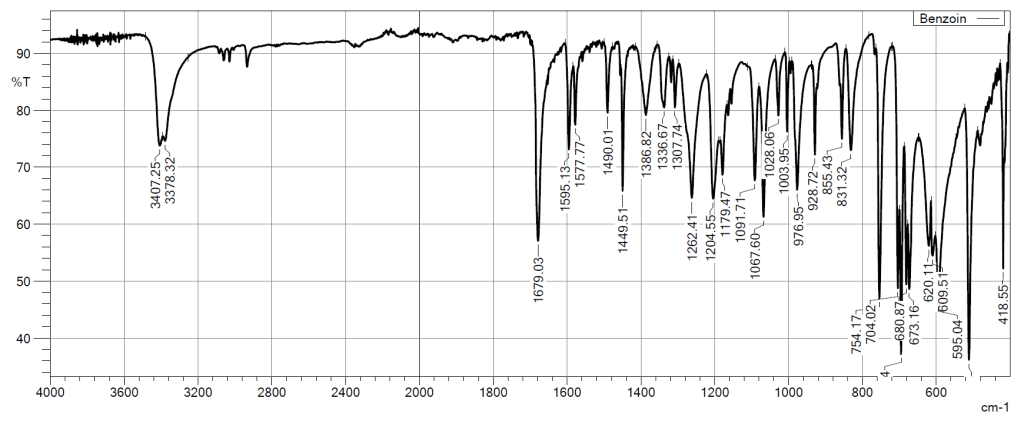
The obtained product was analyzed by Fourier-transform infrared spectroscopy (FTIR) using an attenuated total reflectance (ATR) accessory equipped with a diamond crystal. The resulting spectrum (32 scans, 2 cm−1 resolution) closely matches the spectrum reported in the literature (SDBS No. 1700). Differences in band intensity are consistent with the different sampling techniques used (ATR vs. KBr pellet). A more in depth analysis of the product using NMR can be found in my previous post.
Reaction Trial Without Initial Deprotonation
Following the results of the previous experiments, I was curious to see if, by deprotonating the thiamine directly in the presence of benzaldehyde, it would be possible to trap the catalyst as a benzaldehyde-ylide adduct. This might protect it from decomposition and avoid the initial preparation of the carbene-like catalyst at low temperature. To test this idea, the procedure was carried out as follows:
In a 100 mL flask, 1.07 g of thiamine hydrochloride (3.17 mmol, 0.058 eq.) was dissolved in 3 mL of deionized water. To this solution, 30 mL of 95% ethanol and 5.85 g of benzaldehyde (55.12 mmol, 1 eq.) were added. Then, 2.2 mL of a 3 mol/L sodium hydroxide solution (6.60 mmol, 0.120 eq.) was added to the mixture under constant stirring. The pH was checked and adjusted to approximately 10. The mixture was left to react for 24 h. Afterward, 60 mL of water was added to the reaction mixture, and the precipitate was recovered by vacuum filtration, washed with water, and recrystallized from an ethanol/water mixture. The crystallized product was recovered via vacuum filtration and dried over anhydrous calcium chloride. A final mass of 1.67 g was recovered, corresponding to a yield of 28%.
The low yield indicates that this route appears to be less efficient than the previous ones. This lower efficiency is probably attributable to the partial decomposition of the catalyst during the addition of the base, due to the ambient temperature in conjunction with localized high concentrations of the base. A slightly higher amount of ethanol was also used to avoid excessive precipitate formation in solution, but it appears unreasonable to assume this could impact the yield so severely. Extending the reaction time could possibly help increase the yield slightly, but the key factor still appears to be the initial formation of the carbene catalyst at a low temperature.